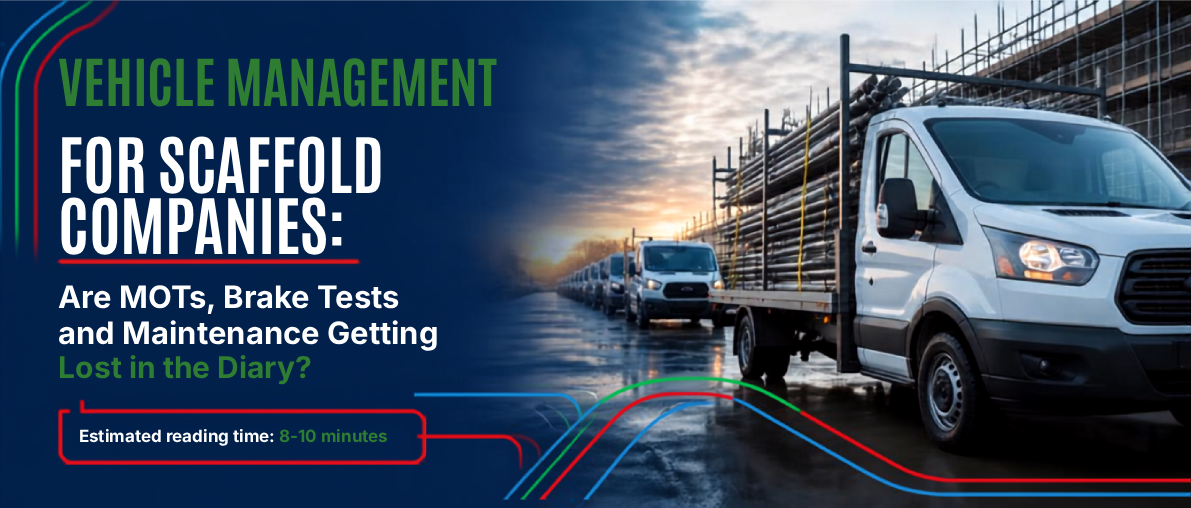
You can have the right gangs, the right kit, and a full order book—then lose a day because a wagon fails an MOT, a brake test has expired, or a service light becomes a breakdown. In scaffolding, vehicles aren’t “support”; they’re part of the production line.
This article looks at why fleet admin gets harder as you grow, how missed maintenance turns into labour and customer problems, and how to build vehicle management into the wider operation so the diary stops winning by default.
Vehicles are part of the scaffold operation (and they control profit)
In most scaffold companies, the vehicle is the link between yard and job. If it’s unavailable, the impact isn’t isolated to “the fleet”—it ripples through the whole operation:
- Gangs — can’t get to site with the right gear, or lose hours waiting for a delivery/collection.
- Deliveries & collections — missed time slots, double-handling in the yard, and re-booked lifts/traffic management.
- Dismantles — a delayed collection often becomes an extra day on hire, a late handover, or a site complaint.
- Customers — you can be “on the books” and still look unreliable if wagons don’t turn up when promised.
- Profitability — idle labour, wasted fuel runs, and re-planning time eat margin quickly—especially on tight-priced work.
Owner reality check: a vehicle issue can turn into a labour and customer issue within the same morning. Treat vehicle availability like you treat labour availability—planned, visible, and managed.
Small fleets are easy to remember—growth makes it easy to miss
When you’ve got a couple of vans and one lorry, you can often manage by memory: “That one’s due soon,” “This one had brakes last month,” “MOT is around Christmas.” It works—until it doesn’t.
As the business grows, the fleet grows, the workload spreads across more people, and the consequences of a miss multiply. A single expired brake test or overdue service can affect multiple jobs across the week, not just one vehicle on one day.
The common setups—spreadsheets, Outlook reminders, paper files, and a separate vehicle diary—can work. The catch is simple: they only work if somebody checks them every week and acts on them early enough.
And here’s the trap: the scaffold diary will usually win. If vehicle maintenance isn’t visible in the same planning rhythm as jobs, it gets pushed back “until next week”… right up to the point where the vehicle forces the decision through downtime or compliance pressure.
| Tool | What it does well | Where it fails in real life |
| Spreadsheet | Simple list of dates and costs | Needs discipline; often updated after the event, not before |
| Outlook reminders | Prompts the right person | Breaks when responsibilities change or emails get ignored |
| Paper file | Good for storing certificates and invoices | Not “live”; doesn’t influence planning unless someone pulls it out |
| Separate vehicle diary | Clear for fleet admin | Disconnected from job scheduling—easy for operations to override |
Planned maintenance is cheaper than unplanned downtime (and easier to staff around)
Planned servicing, brake tests, repairs, and inspections are disruptive—but they’re predictable. Unexpected downtime is where scaffolding schedules unravel, because you lose the vehicle and you lose the plan built around it.
When a wagon is taken out unexpectedly, the knock-on effects typically include:
- Multiple jobs affected — one issue can delay deliveries, collections, and dismantles across different sites.
- Labour problems — gangs stood down, reallocated last-minute, or working without the right kit on site.
- Customer problems — missed appointments, rescheduled works, and awkward calls that damage trust.
- Admin problems — reactive booking of tests/repairs, chasing paperwork, and rushed decisions.
The fix isn’t complicated, but it must be active: brake testing, servicing, repairs, and other requirements need ownership and a routine. If it’s nobody’s job, it becomes an emergency job.
Build a “clear route” for drivers to report issues.
Small faults become breakdowns when drivers aren’t sure who to tell, or think it’ll “cause hassle.” Give drivers one simple process: how to report, what details to include, and what happens next.
Minimum driver reporting standard (keep it simple):
- Report the issue the same day (end of shift is fine).
- Include vehicle, mileage, and a short description (plus photo if helpful).
- Operations acknowledges and decides: safe to run / book in / park up.
- Close the loop: driver gets a quick “booked for Tuesday” or “taken off the road” confirmation.
Records aren’t paperwork—they’re the evidence for better decisions
Vehicle records matter for more than compliance. When you keep MOT dates, brake test history, services, repairs, downtime, and costs together, you get a usable view of what each vehicle is really doing to your business.
Good records support decisions that owners and managers make every year, such as:
- Replacement timing — replace before the “death by repairs” phase, not after it.
- Allocation — match the right vehicle to the right work (and avoid overloading the same wagon).
- Cost control — see true running cost per vehicle and spot repeat faults early.
- Planning confidence — schedule gangs with fewer last-minute changes because vehicle availability is known.
Fleet management should influence the scaffold schedule (not sit beside it)
If gangs depend on vehicles being available, then vehicle management belongs in the scheduling conversation. Otherwise, the diary becomes optimistic: it assumes the vehicle will be there—until it isn’t.
Practically, that means planned maintenance needs to be visible early enough to route work around it. Instead of discovering a conflict on the morning of a collection, you see it when the job is being planned, and you adjust the week before it becomes a problem.
Operational habit to adopt: review fleet due dates alongside next week’s workload (deliveries, dismantles, and collections) every week.
- Identify vehicles due MOT/brake test/service within the next 30–60 days.
- Block maintenance time that won’t cripple a key job day.
- Confirm cover: spare vehicle, hire, reallocation, or split runs.
SDL Pro Management: bringing vehicle management into the wider operation
If the challenge is that reminders and records live “somewhere else,” the solution is to bring them into the same operational system and rhythm as the scaffold work. SDL Pro Management is designed to help scaffold businesses manage operations in one place—so fleet requirements don’t get lost behind the job diary.
What this looks like in practice:
| Fleet need | Managed in one place | Operational benefit |
| MOT reminders | Upcoming MOT dates are visible and tracked | Prevents last-minute scrambles and compliance risk |
| Brake test reminders | Due dates and status kept with the vehicle record | Reduces missed tests and “we thought it was done” gaps |
| Service & maintenance reminders | Planned servicing intervals and booked work recorded | Maintenance becomes schedulable, not reactive |
| Vehicle records | Central history: repairs, certificates, costs, downtime notes | Supports replacement, allocation, and cost decisions |
| Link to operations | Vehicle availability can be considered alongside scheduling | Fewer disruptions to gangs, deliveries, and dismantles |
Key outcome: when fleet management is visible inside the wider scaffold operation, the diary doesn’t “win” by default. Planned maintenance becomes a normal part of planning—just like labour, kit, and job sequencing.
A simple implementation approach:
- Centralise — put MOT, brake tests, service schedules, and records in one system (not scattered across paper, spreadsheets, and inboxes).
- Assign ownership — one named person owns due dates and follow-through, even if tasks are shared.
- Make it visible to planning — operations can see upcoming maintenance early enough to plan around it.
- Close the loop — driver reports become logged actions with outcomes, not verbal messages that disappear.
Conclusion: fleet management isn’t admin—it’s operational control
As your scaffold business grows, fleet management becomes more important, not less. The bigger your workload and the more gangs you run, the more costly it is when a vehicle issue hits the schedule and triggers labour downtime, missed collections, and unhappy customers.
The practical takeaway is straightforward: keep MOTs, brake tests, servicing, repairs, and records under active management—and make them visible inside the same process that plans the work. When vehicles are treated as part of the operation, you plan maintenance early, reduce unexpected downtime, and protect margin.
Next step: review your fleet today and list what’s due in the next 60 days (MOT, brake tests, services). Then decide where that information lives and who owns it—because if it isn’t owned and visible, it will eventually get lost in the diary.