You don’t wake up one morning and decide, “Today we’ll run our scaffolding business on five different systems.” It happens gradually—because the diary works, the whiteboard works, and the spreadsheet “mostly works” … until they don’t.
If you’re growing, the real challenge isn’t that your tools are “wrong”—it’s that the business starts producing more moving parts, more decisions, and more risk than disconnected tools can comfortably carry. This article breaks down what changes as you scale, the warning signs you’ve outgrown your current setup, and how a connected system like SDL Pro Management helps you stay in control while the work speeds up.
Why the “diary + whiteboard + WhatsApp” setup works (at first)
In the early days, a simple toolkit can be genuinely effective because the business is small enough that you can hold most of the context in your head—and your team can still “just ask” when something isn’t clear.
Here’s what typically works well when you’re running a smaller operation:
- Diary / wall planner — a quick, visual way to commit jobs and crew allocations.
- Whiteboard in the office — today’s jobs, key addresses, priority changes, and reminders everyone can see.
- Spreadsheets — customer list, quote tracker, job list, purchase notes, and a basic version of “job costing.”
- WhatsApp — fast comms with supervisors, crews, customers, and subcontractors when plans change (which they always do).
- Paper forms — delivery notes, handover forms, timesheets, toolbox talks, site sign-offs, and inspections.
- Separate invoicing — a standalone accounting package (or invoices created from a template) once the job is “done.”
None of these tools are bad. In fact, they’re often the most practical way to get momentum— especially when cash flow matters and you need to move quickly.
Key point: Early on, speed beats sophistication. Disconnected tools feel fine because the volume is low and the business “memory” lives in people’s heads.
What changes when you grow: it’s not size—it’s operational complexity
Growth doesn’t just add more jobs. It adds more simultaneous jobs, more handoffs, more variations, and more exceptions. That creates more information than the old tools can comfortably handle—and it creates more places for that information to drift out of sync.
When the work expands, spreadsheets, WhatsApp, and paper start to struggle for one simple reason: they don’t naturally stay connected.
Why the same tools become harder to rely on as you expand
The problem isn’t that spreadsheets or WhatsApp are “wrong.” The problem is reliability under load:
- Spreadsheets — great for lists, but fragile when multiple people update them, when versions get duplicated (“final_v7”), or when a job changes mid-week and no one knows which tab is correct.
- WhatsApp — fast, but information disappears into threads, gets forwarded without context, and can’t be audited easily later (who approved what, and when?).
- Paper — simple on site, but slow to return, easy to misplace, and hard to search when you need proof (handover, inspection, compliance, sign-off).
How information becomes duplicated, fragmented, and harder to trust
As you add staff, supervisors, vehicles, and sites, the same job information starts living in multiple places at once—often in slightly different forms:
- Job details — one version in a diary, another on the whiteboard, and a third in a spreadsheet.
- Changes — captured in WhatsApp messages, but not reflected on the schedule or the paperwork.
- Costs — purchases logged “somewhere,” labour in timesheets, hire charges in an email, and none of it tied back to the job automatically.
- Compliance — inspection records and handover forms filed separately, then hunted down when a customer asks (or worse, after an incident).
When information is duplicated, you get two dangerous outcomes:
- Fragmentation — no one can see the full picture without pulling data from multiple places.
- Distrust — people stop believing the system and default to “I’ll just message someone.”
“Ask Sarah” knowledge and switchboard behaviour: the hidden risk
Most growing scaffolding companies develop a familiar pattern:
- One person becomes the human database (often the office manager—let’s call her Sarah). If you want to know what’s happening, you “ask Sarah.”
- The office becomes a switchboard. Calls, texts, and messages route through whoever “knows where everything is.”
This works—until Sarah is off, overloaded, or leaves. Then the business discovers that a chunk of its operational control was actually stored in a person, not a process.
Risk check: If the answer to “Where is that info?” is a person’s name, you don’t have a system—you have a dependency
Where the cracks show first: visibility and profitability
As complexity rises, owners typically lose visibility in predictable areas:
- Jobs & job status — what’s booked, what’s on site, what’s delayed, what’s completed, what’s waiting on sign-off.
- Stock / inventory — what’s available, what’s out on hire, what’s missing, what’s damaged, what should be maintained or replaced.
- Vehicles — who has which vehicle, what’s due for inspection/maintenance, and whether you’re dispatching efficiently.
- Compliance — inspections, handovers, record keeping, and proving it quickly when asked.
- Customer service — customers want answers now: “Are you coming today?” , “Has it been inspected?” , “Can you move it tomorrow?”
- Job profitability — whether the job actually made money after labour, purchases, hire, variations, and rework.
And this is where the most painful trap appears:
More work can hide poor margins if job costing isn’t connected.
When labour is tracked in one place, purchases in another, and invoicing somewhere else, it’s easy to stay busy while profitability quietly erodes. You don’t notice until cash gets tight— despite a full diary.
Why everything becomes one connected operation
Once you’re running multiple crews and jobs concurrently, these areas stop being separate tasks and become one connected flow:
- Design requests influence materials, labour plan, and programme.
- Compliance records need to attach to the job and be accessible quickly.
- Hire, labour, and purchases need to roll into job costing without manual re-entry.
- Quotations need to convert cleanly into jobs and schedules (without retyping the same information).
- Invoicing needs to reflect what actually happened—variations, extensions, additional lifts, and returns—without relying on someone remembering.
The signs you’ve outgrown your current system
You don’t need to hit a specific turnover or headcount before the old setup starts to strain. The clearer signal is this: you’re spending more time reconciling information than using it.
Common signs include:
- You keep duplicate spreadsheets because “we don’t want to break the main one.”
- You retype the same job details into multiple places (schedule, quote, job sheet, invoice).
- Plans change on WhatsApp, but the schedule/office view doesn’t update reliably.
- You can’t quickly answer “What’s the status?” without calling a supervisor.
- You discover missing paperwork only when a customer asks for it (handover, inspection, sign-off).
- Stock availability is a guess until someone checks the yard (or a job is already loaded).
- Vehicles and maintenance are managed reactively (“We’ll sort it when it fails”).
- Profitability is reviewed weeks later—if at all—because costs aren’t tied to jobs in real time.
- The office feels like a switchboard: constant interruptions to answer questions the system should answer.
| If you hear this… | It usually means… |
| “Just WhatsApp me the details.” | The job record isn’t trusted as the source of truth. |
| “Sarah will know.” | Critical knowledge is locked in a person, not a process. |
| “Which spreadsheet is the latest?” | Version control has already failed. |
| “We’re busy, but money feels tight.” | Margins are unclear or costs aren’t
connected to jobs. |
The underlying pattern is consistent: operational complexity increases faster than visibility when systems stay disconnected. It’s not about being a “big” company—it’s about running a business with enough moving parts that you need a single, trusted operational picture.
SDL Pro Management: what a connected scaffolding system changes
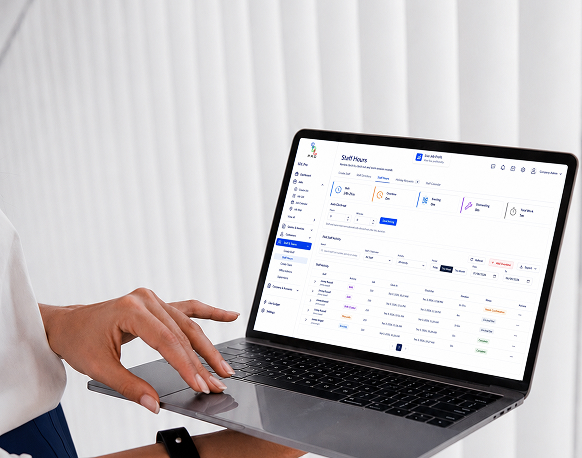
A connected system isn’t about “going digital” for the sake of it. It’s about creating a single operational flow where information is entered once and then stays connected—so the office, yard, supervisors, and customers are working from the same truth.
With SDL Pro Management, the goal is to bring the operational pieces together in one place, including:
- Jobs & scheduling — one job record, one schedule, visible to the people who need it.
- Staff Portal access — give teams the right info without relying on office calls and forwarded messages.
- Clock in/out — labour capture that feeds job costing without manual reconciliation.
- Live job profitability — see how a job is tracking while it’s happening, not weeks later.
- Compliance — keep inspection records, handovers, and related documents connected to the job for fast retrieval.
- Inventory — understand availability, movements, and what’s tied up on sites or hire.
- Hire — track hire components and link them back to jobs and invoicing accurately.
- Vehicle management — visibility of assignments and maintenance so dispatch stays efficient and controlled.
- Customer Portal — reduce inbound chasing by giving customers appropriate visibility and updates.
- Design requests — capture requests in a structured way that feeds planning and delivery (rather than living in message threads).
- Quotations — build quotes that convert cleanly into jobs and schedules without rekeying.
- Invoicing — connect what was delivered (including changes) to what gets billed, with fewer missed chargeable items.
What “connected” really means: When a design request changes, the schedule, staffing, materials, compliance, and billing can stay aligned—without someone manually updating five separate places.
Conclusion: growth should give you more control, not less
Spreadsheets, WhatsApp, and paper aren’t the enemy—they’re often the tools that helped you grow. But once operational complexity crosses a line, those tools become harder to trustbecause they can’t keep information connected as fast as your business moves.
The takeaway is simple: growth should give the business more control, not less. The right system helps information move as fast as the work does—so you can scale jobs, crews, and customers without scaling confusion, risk, or margin loss.